ABSTRACT

The Ethics of Infinite Love.

 David Banach

Department of Philosophy

Saint Anselm College


And you shall love the LORD your God with all your heart, with all your soul, with all your mind, and with all your strength.’[a] This is the first commandment.  And the second, like it, is this: ‘You shall love your neighbor as yourself.’[a] There is no other commandment greater than these. ---Mark 12:30-31


If a thing loves it is infinite.--- William Blake


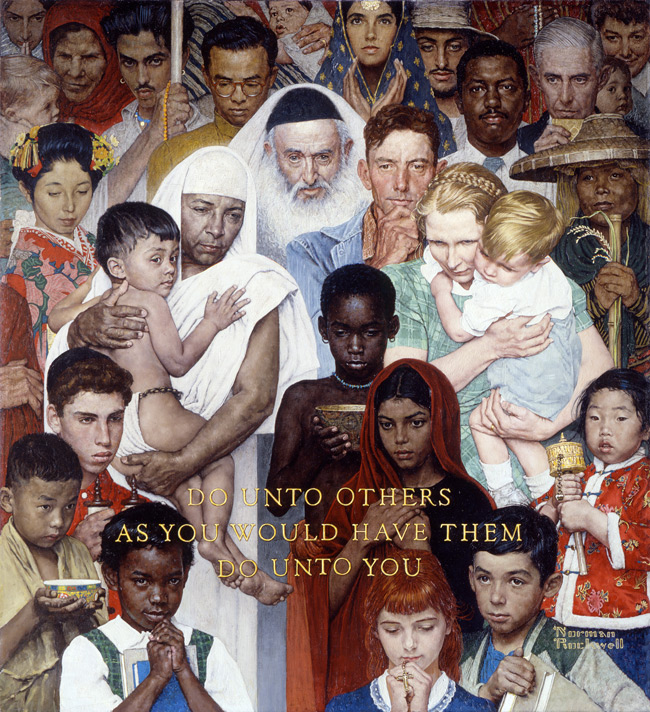
Love goes beyond all bounds. Two things loved with all one’s heart must be equal. If you love others exactly as yourself, there will be no way of choosing between them, or between them and you.

It is often thought that a teleological ethical system, one that derives its theory of moral actions from a theory of the good, cannot account for the intrinsic value and dignity of human life. Utilitarianism, for example, is often criticized because it seems to make the overall happiness of a group justify sacrificing the values of the individual. The needs of the many seem to outweigh the needs of the few. But this only applies if the goods being balanced are finite. No number of finite goods can balance an infinite good.

While we shouldn't pretend that using mathematical language gives our ethical intuitions more precision and certainty than they have, I do believe that there is something to be learned from looking at the way in which mathematical concepts of infinity work. Just as it may seem strange that no collection of finite numbers will add up to an infinity, so it may seem strange that no number of grasshopper lives will add up to a human life. Infinite quantities also confound our intuitions when we add finite numbers to them (no matter how much you add to infinity, you still just have infinity) and when we consider adding infinity to infinity (no matter how many infinities you add to infinity, you still just have infinity).1 So it may seem strange that no matter how much finite value we add to a human life, it is still not worth more than another; or that no matter how many human lives we take together they still do not justify the willful destruction of one human life. Much of what is strange about the value of human life is part and parcel of the strangeness of infinity.

What makes the value of a human life infinite? This is a bit harder to say, and while here I am mainly interested in drawing out the consequences of this proposition rather than defending it, I do think that there are two useful things one can say: (1) A will that loves goes beyond all bounds. When you care about something, all other things being equal, you care about it always and everywhere. To feel joy is to desire to feel it always. To grieve at the loss of a child, is to grieve for all the lost children, wherever they may be. Though our will finds itself impotent to create the realities of the things it values, the reach of its commitments is not bounded by space or time. (2) The will can order its values into systems of commitments that transcend the individual values from which they arise, in fact, the will may be defined by such abilities. Our love for a person is more than just the sum of our enjoyments of the moments we've spent with them. Just as a melody is more than just the sum of its notes, the will synthesizes our values into new unities that transform the individual values as they come to exist within the new whole. One of the great discoveries of Gregor Cantor was that there are levels of infinity even greater than the infinity of the natural numbers. The number of real numbers on the number line (including both the rational and the irrational numbers) is a level of infinity (aleph one) that cannot be reached by adding any number of infinities. This new level of infinity arises from taking the power set, the set of all subsets, of the natural numbers. In an infinite world of values, the will has an unbounded ability to synthesize new values, integrating novel combinations of commitments in new ways. We can love things in more ways than there are things to love.

What would an ethics of infinite love look like? It will not generate a rational procedure to determine with certainty what you should do or to be sure that you have done what is required. There will be no unique way of balancing infinite values against each other, nor any way of satisfying the infinite demands of our values. It will not spare you the anguish of moral choice nor the urgings of conscience.

With no recipe for action, it will be the character of our love that will matter rather than the characteristics of our action. The two commandments quoted above are the best summary of such an ethics, and they might be summarized more succinctly as “Love the good without bounds” Or as C.S. Lewis puts it, “act in time, as beings destined for eternity.”2 The Christian virtues define the types of commitments of the will that give rise to such actions, and the seven deadly sins define the types of actions that prevent it. A Christian ethics should return to a concentration on the state of the will from which an action flows and its fitness for eternity

But what does this imply about how we should act in concrete situations? How do we balance one infinite good against another? We already have a model for how we do this in balancing the needs and demands of siblings or family members all of whom we love equally and none of whom we can choose over the other. In these cases I believe we use three kinds of considerations to order our actions out of love: 1. Opportunity; Do the good you can, when you can do it and where you can do it; (2) Engagement: Love as much and as fully as you can. Express your love as fully as possible to as many of its objects as possible; (3) Efficacy. Express your love where it can act most potently and act so as to increase the power of one's love. These can be suitably summarized in a slogan such as “Love now, love more, love stronger.”

Most traditional ethical theories have two types of concerns that are not properly ethical: (1) Determining ways of dealing with immoral behavior including (a) determining what actions we should force people to perform or prevent them from doing; (b) determining what punishments of provisions a society should make for forcing persons to act morally; (c) determining what actions we should praise or blame; (d) determining what rules an systems of behavior we should apply to inculcate habits of moral action in those who by nature, character, or upbringing find themselves unable to do so. Each of these is a separate act (to praise, to compel,to punish, to train) from the judgment of the action itself and requires its own justification. It does not follow from “x is immoral” that “y is the most moral way of reacting to x,” where y is some particular act of praise, punishment, or force. (2) Protecting moral agents from the infinite demands that our care for things imposes on us. Moral theories that aim at the logical deduction of the moral action in any given situation answer the question: “How can I be moral?” They allow one to consider oneself moral even when not acknowledging all of the goods involved in a situation, the infinite demands placed on us by loving all of our neighbors as ourselves.

the

An ethics of infinite love would also mean that we can never meet the infinite obligations that our love places on us. Once you start caring about the hunger of children, you will find that there are more of them than you can even think of, let alone feed. Once you allow yourself to feel the infinite value of each set of eyes that look at you, you will feel yourself to be, in Dostoevsky's words “responsible to all, for all.”

This is not meant to be an invitation to despair; we were given wills that, while impotent in their power, were infinite in their reach. It is the depth of our care that leads to its infinity; we do not cease caring about things simply because we cannot achieve them: We feel our loves, for the things we care most deeply about, as a thirst for which there is no quenching3, from a cupful of goods that knows no bottom. The ethics of infinity reveals us to be creatures always in need of redemption, but also as beings capable of living in its hope, in the draft of a current that ends beyond the horizon.

1This is more precisely stated by saying that all ordinal infinities (those arrived at by adding one more) all have the same cardinal number (aleph null); all are still equinumerous with the natural numbers or integers, or are still countable infinities.

2This is a paraphrase of The Screwtape Letters, number XV.

3This language is reminiscent of Emmanuel Levinas, Totality and Infinity, 113.